The music's on point, then suddenly, you're not...
Don't worry, it happens.
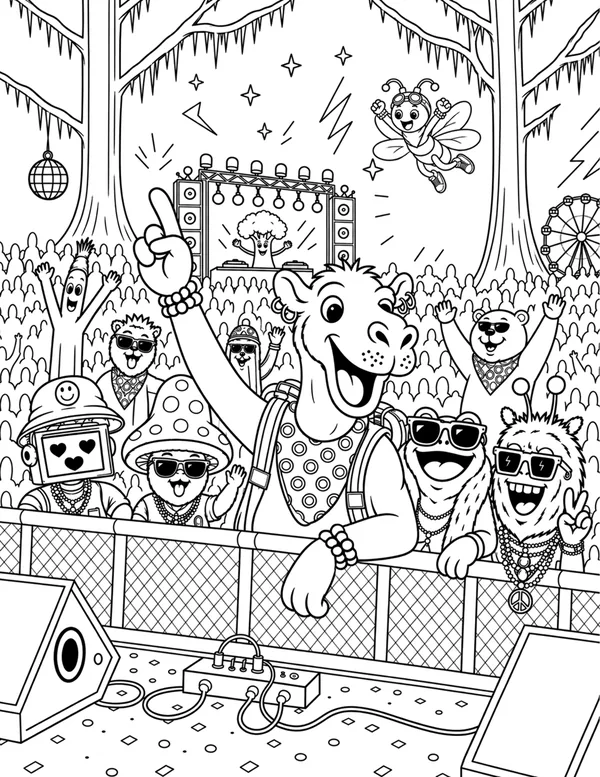
Meet six festival friends in six sticky situations: an exhausted camel; a solo flip-flop; a frazzled fox; a stormy cloud; a tangled-up snake; and a bummed-out glowstick.
Each one finds their way out through 8 simple steps, based on proven methodologies used by peer-support professionals in sanctuary spaces around the world. Color the page. Do the step. They find their way and you can, too.
The stories and methods behind the magic
All 6 stories walk eight real steps that help get you through real situations.
Curious what the steps are? Going through something right now, or helping someone who is? Tap a situation below for a cheat sheet and a plan to get through it.
1Running on EmptyForgot to listen to your body
It's easy to lose touch with our bodies when we're caught up in the moment. Regular check-ins with your body, frequent small refuels, and the occasional shady seat are a recipe for success.
1
The Problem – OverexertionNotice when “just one more set” has been running the show for hours with no breaks.
2
Body Signals – H.O.T.T. CheckCheck yourself for Hungry, Overheated, Thirsty, and Tired. Any one of them is a reason to pause.
3
Shade & CoolFind shade and cool down first. Cool the body before you try to fill it.
4
Sip SlowlyDrink in sips, not chugs. Steady hydration beats playing catch-up.
5
Eat SomethingEat, even if you don't think you're hungry. Even a little is better than nothing.
6
Rest Between SetsSit out one set, or sit down for a few songs. Pacing yourself is what gets you to the end of the night.
7
Return RechargedMake a plan: sip regularly, snack on a schedule, find shade before you need it.
8
Resolution – ThrivingNotice how different your body feels. The bass hits different when your body's on your side.
2Lefty's LostA journey to find what's missing
A lost friend, a lost phone, a lost purpose. These are all potential outcomes when swimming in a sea of friendly strangers. Stop the spin, make a plan, and you'll be found before you know it.
1
Understand the SituationName what's happening: “I'm lost, my person is gone.” Naming it stops the spin before it starts.
2
Stop the SpinStop moving for a moment. Pause for one song before doing anything else.
3
Ground – SeeName five things you can see around you. It pulls your mind out of panic and into the present.
4
Ground – Touch & HearName four things you can touch, then three things you can hear.
5
Ground – Smell & TasteName two things you can smell, then one thing you can taste. Now you're here. Welcome back.
6
Once Calm, One Small PlanPick one concrete next move: a landmark, the place you last saw your person, your favorite spot in the area.
7
One Step at a TimeStart walking toward it. You don't have to solve it all before you move.
8
ReunionNotice when you've made it. Let the relief land.
3Too Much EverythingSensory overload
All the sights, all the sounds, all the feels. These environments can be a lot. If you're feeling anxious or overwhelmed, that's understandable. Check out the steps below for a way out.
1
The Problem – OverloadNotice when sound, light, and crowd have stacked up past what feels okay. That's overload, not failure.
2
RetreatMove toward whatever quieter, dimmer space is nearby. Choosing less is always allowed, mid-set or not.
3
Reduce StimulusFind somewhere dim, soft, and slow, with nothing required of you. Less input is the whole point.
4
Soften – Top HalfScrunch your ears, clench your jaw, squeeze your shoulders up high, then release. Repeat a few times.
5
Soften – Bottom HalfKeep going down: scrunch your legs and feet tight, then release. Let the tension drain out.
6
BreatheLong breath in, and a longer, slower breath out. Let it find its own slow rhythm.
7
Re-Emerge When ReadyCome back out only as far as feels good. A hammock view counts as much as the front rail.
8
Resolution – Your Own ExperienceYou get to choose how much you experience. Exactly enough is exactly right.
4The StormA fight that floods
With so much going on around us, it's easy for wires to get crossed. In the heat of the moment, a best friend can unintentionally turn into an adversary. Read below for how to find your way back.
1
The FightRaised voices, a sudden wave of anger. That's the signal to pause before it gets bigger.
2
Step AwayPut a little distance between you and the moment. It isn't giving up; it's giving the storm room to pass.
3
Calm Breath – Box BreathingBreathe in for 4, hold for 4, out for 4, hold for 4. Repeat at least a few times.
4
Name the FeelingAsk what's actually under the anger. Often it's hurt, or care, not fury.
5
Perspective-TakeConsider the other person's side for a second. What might they have been feeling or caught up in?
6
Plan the RepairDecide what you want to say: not to win, but to fix it. A short, honest sentence beats a long defense.
7
ReconnectFind them, say what you planned, and give them space to say what they need to as well.
8
ResolutionNotice the relief when it's settled. A bond is often stronger for having weathered something together.
5Knot AgainThoughts caught in a loop
Big nights can stir up big thoughts. Sometimes one gets stuck on repeat and feels like it'll never stop, but it always does. Whether you're the one tangled or sitting beside a friend who is, the steps below will help loosen the knot.
1
Understand the SituationSay it out loud, even just to yourself: “I'm in a loop.” You can't work with what you won't name.
2
Guide to a Peaceful SettingMove somewhere calmer: dimmer light, less noise, a steady friend nearby.
3
Sitting, Not GuidingHelping someone? Sit beside them without trying to fix things. Presence beats advice.
4
Talk Through, Not DownSay the loop out loud to someone who'll just listen. Being heard breaks the seal.
5
Difficult ≠ BadA hard experience isn't a dangerous one. “This is difficult” takes the panic out of “this is scary.”
6
Calm BreathingBreathe in for 4, out for 4, for a few rounds. Loops run out of fuel without full attention.
7
Ride It ThroughStop fighting it and let the wave crest and pass. It always completes.
8
ResolutionA small gesture, a shared bracelet, a deep breath. Mark that it's over and you're okay.
6Glim's GlowFeeling dimmed out
After an incredible high, the low is sometimes not far behind. Take a pause. That's the swing: feeling both the highs and the lows is part of being human. If you're feeling low, the steps below will help you climb back up.
1
Problem – The DipNotice the low point without panicking about it. Everyone dims sometimes.
2
Notice & Name the FeelingSay what you're feeling out loud. It becomes a visitor passing through, not something you're stuck with.
3
Current Chemistry, Not TruthA low feeling is chemistry and tiredness, not character. It lifts. It always lifts.
4
Common HumanityEveryone dips sometimes, even the ones who look like they never do. Nobody dips alone.
5
Self-KindnessAsk what you'd say to a friend who felt this way, then say it to yourself.
6
RestLet yourself truly rest. No agenda and nowhere to be.
7
Tomorrow Always ComesTrust that the low won't last. Mornings have a way of doing some of the work for you.
8
Resolution – The LiftNotice the small spark come back. It's just enough to keep going.
Want a copy of your own?
All six stories, all 48 steps, and a page to color for every one. For your bag, your camp, or your squad.
This is a comfort tool, not medical advice. It doesn't diagnose, treat, or cure anything. It just sits with you, which is all we really need sometimes.
If someone is in medical danger (trouble breathing, unresponsive, severely overheated, physically injured, etc.), please seek professional help immediately. Find event medical staff or call your local emergency number. That's never overreacting.
Bulk orders, questions, or feedback?
Want copies for your sanctuary space, harm reduction team, or crew? Have a question or something to tell us? Send us an email.